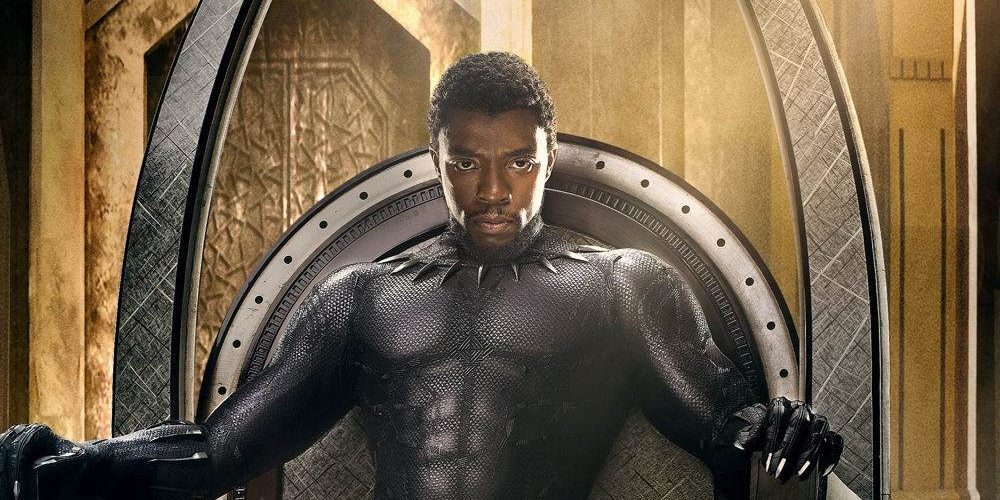
It feels like there are very few times in popular culture where Black Americans get to actively participate in positive discussions about themselves. With the release of Black Panther, we get to have a moment to exhale and relieve all the built up tension surrounding civil rights and equality. Black Americans get to stand tall with next to a culture that has been erased from our identity, replaced by our own version built out of slavery and poverty, ingenuity and resistance, but reminded every day as Black Americans, we are Black first, and Americans second. And while America will always be our home, Wakanda offers a positive representation of everything we could be, can be, and will be. As its most enticing feature, Black Panther delivers a story that any person can relate to, regardless of their skin color, affluence, or place in the universe.

I was in a unique position during my viewing of Black Panther, I went to see the movie with my father. My father is White. That kind of 5th generation American White that is completely devoid of any external culture, ignoring his Irish and Scottish heritage all his life. It would have been even more unique with the addition of my mother, who is Black, but she unfortunately had the flu, so now we all have to settle. I wanted to have a conversation with the both of them about the film, the hype, their lives, my life. Frankly, this is probably the only time in my adult life I have actually WANTED to have a conversation with them together on any topic surrounding race. Though they have been married 37 years, they are very much oil and water on many subjects. But hey, that’s how you make great pasta, right? Maybe. But first, let’s get into the movie. How was Black Panther? In short, not as unique as all of its parts. And to discuss the film in its complete capacity, the following is rife with spoilers. Reader beware.
*****SPOILERS BELOW******

Taking a step back, having to looking at it from space because up close it shines too brightly, there is nothing new about the story in focus, just the lense from which it is viewed and the stage on which it sits. I am not sure what I expected, but the story falls on one of the only tales of Kings, successors, and subjects. The story has a classic Shakespearean tapestry, woven with betrayals, truces, romance, and family. Despite the death of their King T’Chakka (John Kani) (which happened in Civil War), most of Wakanda is excited to see his son take over the kingdom. Shortly after taking the throne, T’Challa (Chadwick Boseman), has the opportunity to avenge the deaths of his best friend’s parents by capturing Klaue (Andy Serkis), a career criminal who has escaped justice for 30 years and was able to infiltrate and escape Wakanda with their major natural resource, Vibranium, a fictional metal that aided in their technological advancement. Failing to capture him causes his best friend, W’Kabi (Daniel Kaluuya), to feel betrayed, having been let down by T’Challa’s father as well. Meanwhile, T’Challa learns from his father’s close friend Zuri (Forest Whitaker) that his father was forced to kill his own brother in order to save his life. Afterwards, T’Chakka knowingly left his brother’s child Erik Killmonger (Michael B. Jordan) behind to survive alone in 1992 Oakland. The abandon Killmonger returns to Wakanda just after T’Challa’s ascension with Klaue in tow, turning him in to garner the goodwill of the royal guard, notably W’Kabi. After revealing his bloodline, Killmonger challenges T’Challa for the throne. These are all the major turning points of the film, and none of them are at all surprising. This is my sole issue with the film, and even still, it excelled at re-telling this age old story.

People have heralded the story for enticing you to feel compassion for its main antagonist, Killmonger, like no other marvel story before it, but that is exactly what this story is designed to do. Evil is perspective. Everything is perspective. Killmonger may be brash, but his single minded charge to the finish line is paved by good intent. What’s more, he is easily the most identifiable character in the film. Life is much more akin to Killmonger’s than to T’Challa’s. We rarely are thrust into positions of leadership without volunteering, but we are often left behind by people around us. Everyone has a personal story that can put you in Killmonger’s shoes. I feel my own Blackness is wrapped up in a similar story. Growing up, my mother’s side of the family, all Black Americans from Dallas, would tease me for the way I spoke, how different I was, and would always tell me it was because of my White half. My mother for most of my life has often commented on how un-Black I am. I pointed to the fact that I grew up in the suburbs of Austin in a predominantly white and hispanic neighborhood probably had something to do with it. She tried to surround me with Black peers, but they were avid fans of sports, music videos, and church whereas I found entertainment in video games, science-fiction novels, and movies. Blackness was limiting. This was a great divide between me and my Black peers, or it seemed like it to a little kid. Black nerds were a rarity, so rare at the time, I wouldn’t meet any until high school. Still, two Black nerds couldn’t make up for all the Blackness I was “missing”. Essentially, I grew up feeling like an outcast. My White friends would call me their token Black friend, my Black friends would call me a nerd or too white or “High-Yellow”, a term for light skinned Black folks. But that didn’t change the fact that I indeed walked around everywhere in the same skin, with the same problems, and probably a few others, as I also have been confused for Filipino, Egyptian, Mexican, and my favorite “Gay Cuban” (long story). Killmonger’s story resonates so well because at some point we have all felt alone, rejected, or forgotten. The film makes a point of showing that Black people carry sins of their own, perpetrated against their own, regardless of the best of intentions. But Black Panther also points to the fact that we can redeem ourselves, forgive ourselves, and break free of oppression inside and outside our community. When we all stand tall together, regardless of our backgrounds, our skin tone or color, we are stronger for it, a moral as old this story.

By the time the credits and post-credit scenes had run, I was excited to see how my father felt about the film. To characterize him a little bit, he is an avid reader of fantasy novels like Conan The Barbarian and Lord of the Rings. He is quiet, non-threatening, bad at reading social cues, stubborn, and a little self-absorbed. He was the kind of parent whose name you could say 10 times, and never notice. He tends to take everything personally, so while I was excited to hear his opinion, I wasn’t at all surprised with the result. His personal take was, “Eh, I liked it.”
“And…?” I replied.
To which he launched into a thought about how he is “tired of being blamed” for everything bad that White people have done to Black people. My father is not terribly deep or analytical, but he could tell that the film had broached this topic somewhere underneath the surface, if not addressed in the media in weeks leading up the release. In his eyes, he married a Black woman, raised a Black son, attends a predominantly Black church wherein he has many Black friends, how could anyone see him as racist simply for being White? Again, he takes everything personally, it’s just the type of person he is. I told him that this isn’t about any one person. This is about recognizing the disparity. You don’t get to choose your privilege, so no one is blaming you personally. It’s about working towards change without expecting a reward. No Black hands are going to be patting you on the back. I told him that maybe he personally had done enough, who can really say, but the last thing you need to do is change your perspective and recognize this isn’t about you or what you have done. There is much more that needs to be done, we have much further to go. Black Panther is a step in the right direction.

Wakanda undoubtedly leaves an impression on everyone who sees it, but more impressive than its city is the plains, mountainsides, and other tribal homes. It has a very zen like feel to it, one that is completely enshrined in nature, yet there is utility in its beauty. Every aspect of the costume design feels modern, even when making homages to long time African garb. The hairstyles, more specifically the lack thereof, shine more than any film in recent memory. Okoye (Danai Gurira) is not only the complete fashion stand out of this film, but by far the strongest actor and character in the cast. By the end of the film, you want every other Black Panther film to star her alongside Nakia (Lupita Nyong’o), the resident Wakanda spy and
strong wing-girl
to Okoye, as they take the mantle of the Black Panther. It’s also impossible to ignore Shuri (Letitia Wright) as the brilliant resident scientest. This isn’t to say Chadwick Boseman didn’t bring it, he plays a great role model with a cool, calm charm unmatched in the MCU, but his character offers little else to be desired. He reacts to everything around him more often than creating the moment. Gurira and Nyong’o steal the scenes with their brand of wit and intensity, and natural scene maker Angela Bassett, T’Challa’s mother Ramonda, helps broaden the world of Wakanda. These are the strongest female cast of characters in the entire MCU, and it would be a safe bet for them to continue to take center stage whenever possible. Also deserving of special praise is Michael B. Jordan, who strikes a balance as the tragic villain better than anything we have ever seen in the MCU, including Bucky Barnes. His costuming is quite possibly the most visually striking aspect in this film, markings lining his skin for every kill in his past.

Black Panther also sports some of the best action sequences in the MCU, predominantly because while he is a strong superhero, he doesn’t really have a gimmick beyond increased strength and agility, similar to Captain America. We get to see his suit used in action multiple times times, but the fights are generally up close and personal. The car chase scene is probably one of the films bigger moments, running up the sides of buildings and surfing on cars, but it really shines in the smaller moments, fighting on waterfall cliff sides and hand to hand on train tracks. The actual brutality in the film was unprecedented as well. There are plenty of moments where this film could have easily jumped to an R-rating. Particularly when Killmonger is involved. This caused an uncertainty in the fight scenes. Even though we see Captain America take some hits, nothing hit as hard as watching T’Challa take a spear to the arm or watching Killmonger headshot his own allies. And every brutal moment is beautifully captured and edited. This was truly a labor of love.

Time to step down from the pulpit and give you some final words. Director Ryan Coogler took something immensely personal and made it universal. He continued a difficult conversation in a profound way, without mincing words or laying down meaningless platitudes. Just as much as Wonder Woman stood up for women last year, Black Panther stands up for equal representation, for unity, for woke-ness. Just as much as I was able to see myself in Killmonger, so to can anyone else. Coogler was able to land the exclamation point at the end of James Brown’s famous words so we can all say, “I’m Black and I’m proud!” And yet, this film is both about and beyond being Black. You don’t need to be represented by a skin color. Little White, Asian, and Hispanic kids can see themselves in the people of Wakanda. We can tear down the wall and reach an understanding. Black Panther stands for everyone. I think that’s something we can all recognize.
~* 9.5/10 *~
Leave a Reply