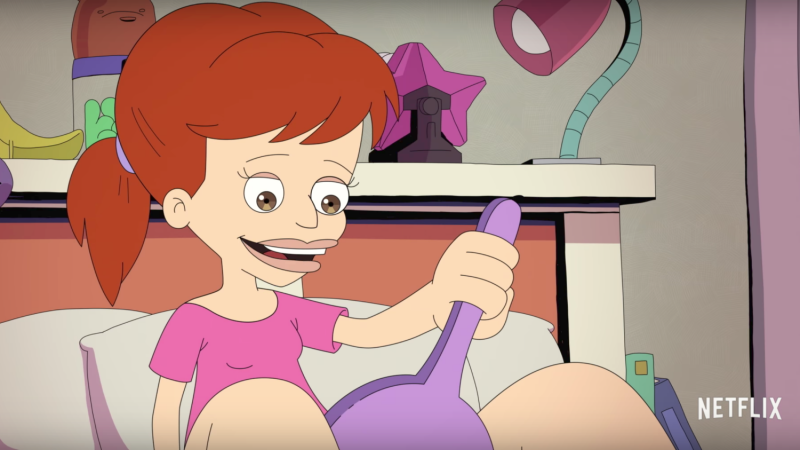
I was powerless to resist Big Mouth. Like the inevitability of growing older, hairier, and fatter, I was drawn in by the concept of an overtly adult animated show featuring the trials of pubescence. The promise didn’t need to be any clearer than showing boy battling his urges and a girl talking to her vagina, but it became clear that the audience they were aiming for was the mixed bag at Blink-182 concert circa 2002, adults by now but with that edge that still says, “I love a good dick/pussy/fart joke”. Classy. And while they rounded out the bases this season, tackling 7th grade science basics, it left a lot of voices out, primarily everyone who isn’t white and Jewish.

Yes, it is 2017, so the buzzword is still the ever present “whiteness” of America. While this isn’t my main complaint, it does make the show one sided on the male side. Our two main protagonists Nick (Nick Kroll) and Andrew (John Mulaney) are two sides of the same coin, affluent and Jewish, Nick a bit more outgoing and Andrew instilled with the classic Jewish anxieties common to the comic forefront. Poor of character, Jay (Jason Mantzoukas), might be the low class perspective with an absent, workaholic father and mother whose concept of parenting and masculinity are highly suspect. While he is ambiguous in culture, if he is counterpart to Jason, he could be Greek, but I think Jersey is meant to be his primary character trait. Either way, while much of the culture surrounding male puberty is universal in America, the show doesn’t make a point to invite the various cultural backgrounds to the table, instead leaning mostly on north-eastern American Jew. Still rife with comic sentiment but I couldn’t help but feel it lacked a truer vision of the American pubescent experience. The only black male character is the ghost of Duke Ellington, almost inexplicably living in Nick’s attic (he died in the house), who dishes out ill advice, adversely fulfilling the role of the “wise old black man” stereotype, but not escaping it completely. While I may have been in stitches, I couldn’t help but wonder what a Black, Hispanic, or Asian family would have brought to the table. Maybe they thought it would be too divisive.

My first place gripe, while figuratively and literally coming in second in the show and this writing is, why are the leads even male? They have more screentime and the brunt of the story leans on them while Jessi (Jessi Klein) and Missy (Jenny Slate) are ushered more often to the B-story. In the case of the content of the show, it would be hard for them to pass the Bechdel test since all the characters interact in and out of relationships, so that really isn’t the issue. In the first episode, Jessi inquires, “How come in all these videos puberty for boys is like the miracle of ejaculation, and for girls we’re just a yarn ball of aching tubes?” This sounded like a triumphant statement. I was sure the show was going to focus on the girls with equal favor, but it rang a bit hollow by the end of the season. While the girls share some great moments with the audience, many of their issues stem from their relationships with boys or others rather than with themselves as girls. At this point, I began to question if that was simply a matter of common sense. Is the nature of female puberty grounded primarily in how their sexuality is perceived by others rather than an internal monologue the boys tend to have? Or, more likely, is it that as a culture we (predominately the patriarchy) lack the ability to comprehend the truth of the female experience?
Comedy is born of the comprehension of the state of being, so without this basic understanding of the female experience, largely born of a culture that sees women as an accessory, are women able to take the stage under the male dominated spotlight? There is rarely a time growing up or when we are older where mixed company finds ways to laugh about female puberty. You can laugh at a boys nocturnal emissions but generally not about a girls first period. However, we grow up celebrating the male, his coming of age sexually and his conquests, and this show is not much different. Big Mouth is not devoid of the signs of cultural growth, with positive messages in the form of interracial marriage, sex positivity, and male/female relationships. And here I am, a male whose understanding of the female conquest begins and ends with shows like Sex and the City, The L Word, and Desperate Housewives, all of which star women in their late 20’s to 40’s and beyond, discussing coming of age rarely if not passively. All I can really do is speculate while the comic landscape repeats the stories popularized in my day by Adam Sandler or Jason Biggs, juvenile and one sided.

While I find time to put myself out there, I am still at fault, not often diving into unfamiliar waters for new material. I was really hoping this would usher in a bit more female oriented material, maybe some I had never thought of before, but maybe that will be reserved a second season. Despite how you may feel of the overtly sexual material oriented around 7th grade children, it’s honestly not as disgustingly graphic as shows like Drawn Together. I won’t say it’s poignant, but it’s not exploitative. Well, not in a creepy way.
Leave a Reply