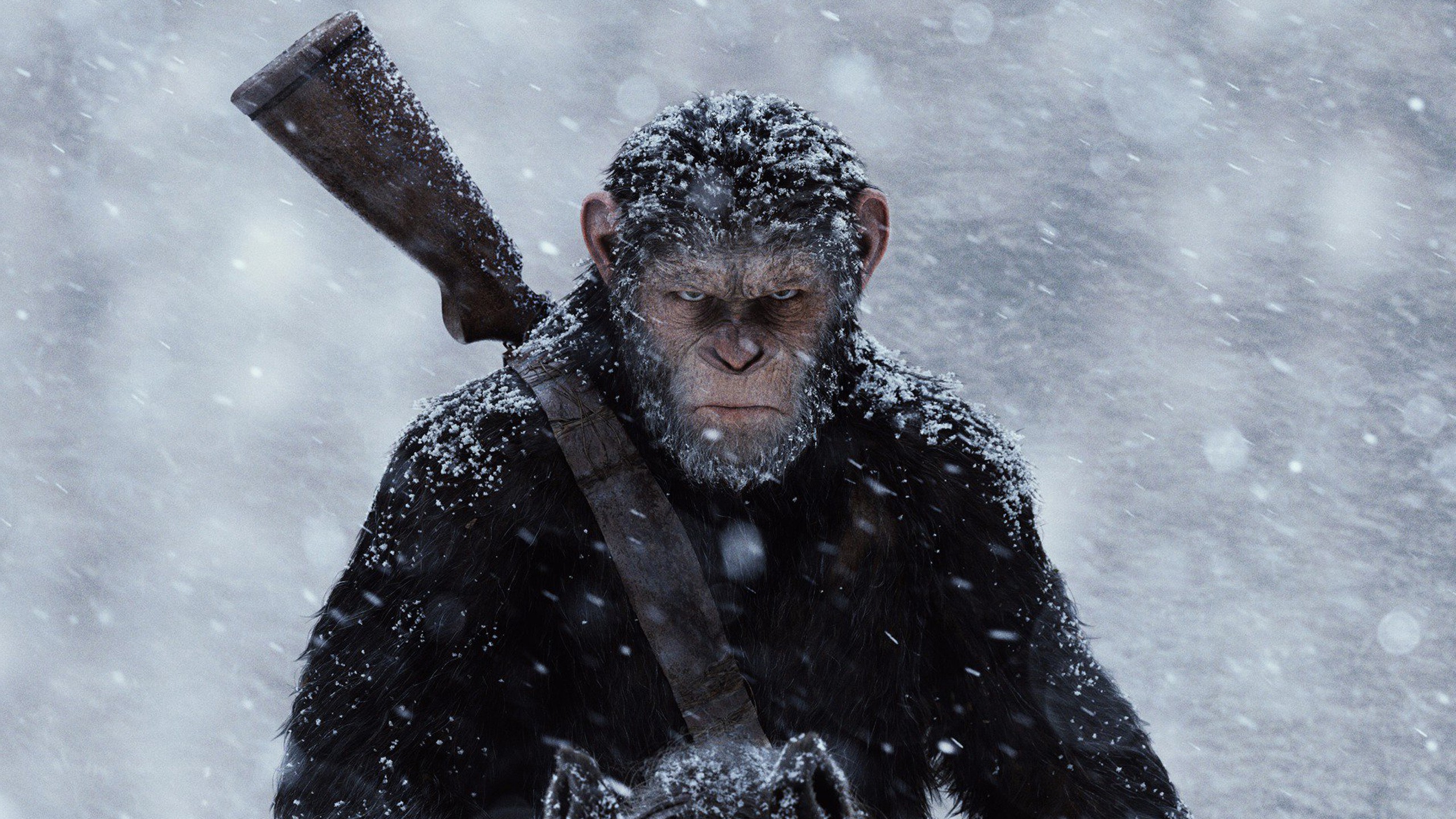
War. War never changes. Even when the combatants are humans and super intelligent apes. War for the Planet of the Apes is a heavy handed series of metaphors and allegories on the titular subject, using imagery of religion, nationalism, slavery, and racism. It is as poignant as it is brutal, even if it comes of a little clumsy here and there. Reminiscent of POW war films like Bridge Over The River Kwai and The Great Escape wrapped inside an Empire Strikes Back exterior, it wraps up the worst parts of American history to deliver a parallel of our current local and global climate. It’s not often an evolving science-fiction series mirrors the climate as they are released on the big screen.

Largely, this War for the Planet of the Apes isn’t necessarily anything new, especially when it comes to science fiction and humanity, but it’s a harsh reminder of how flimsy our society stands in the face of our more base survival instincts. The story takes place sometime after Dawn, the apes have taken refuge in the Muir Woods while a military sect called Alpha Omega look to dismantle and destroy their society. In an effort to garner peace, the apes offer an olive branch, but the humans strike it down. The performances are largely relegated to Andy Serkis as the ape leader Caesar and Woody Harrelson as the leader of a sect of the human military. In the apes, there is so much strength in the depiction of a silent group who communicates largely without a voice, via sign language. Caesar, who is able to speak and negotiate on the same plane as humans is often steamrolled because of what he is and represents, similar to historical incidents with Native Americans and later the Civil Rights Movement.

Visually, there is rarely a dull moment. The movement of the apes is still an amazing feat and graphically, they look better than ever. There are moments in this film where comedy undercuts the war tone from time to time, most of them by Steve Zahn’s “Bad Ape”, which I felt were well timed but completely unnecessary. This film also doesn’t utilize Woody Harrelson as wholly as it should have. He isn’t stuck in the background, he is a large part of the film, he just isn’t as big as I thought he would be, never stealing focus or chewing the shot. During Caesar’s journey, he comes across a young girl (Amiah Miller) who is unable to speak and still does a wonderful job conveying a range of understanding for someone so young and without using words. She is supposed to be the onscreen shorthand for innocence, white and blonde and blue-eyed, but I can’t help feeling this would have been a good place for child of color to shine a bit, cutting through that shorthand for the betterment of film as a whole.

There is much to be had seeing this on the big screen, especially if you are a fan of the series, and though this film was enjoyable, it doesn’t demand urgency. It has plenty of interesting perspectives on war and humanity, especially juxtaposed to the current political climate in America. But considering the real life 3-ring-circus that it is today, there isn’t as much impact to its message. There are times that the film favors making a point over making sense, logistically or otherwise.
put forth tremendous effort in this outing, and it certainly has its moments, but it falls far short of greatness and settles for goodness.
~* 8/10 *~
Leave a Reply