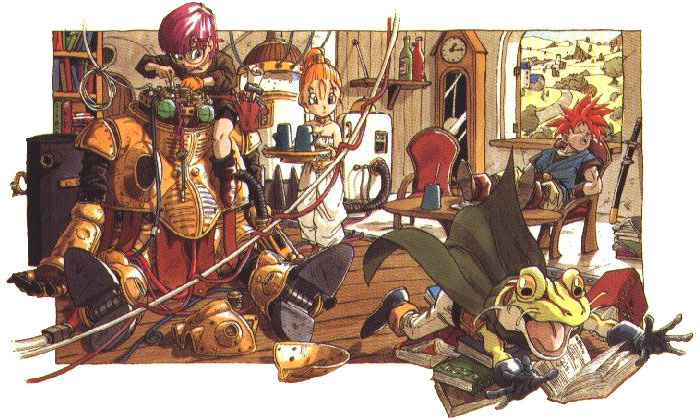
Chrono Trigger might be considered the strongest game in the Super Nintendo library. And who could argue? It has an instantly recognizable art style, streamlined gameplay, a tightly written storyline, spectacular score, and memorable cast of characters. That really makes up a lot of what you could ask of an RPG, or any video game. However, to this player, one aspect has always stuck out like tacos at a chinese restaurant – the silent protagonist.

You can attribute all of the aforementioned characteristics of Chrono Trigger as to what makes it so hard to create a successful sequel. Chrono Cross set out to give fans more of what they wanted without securing most of the important assets from the original development team. While that’s not really the issue at point, we are going to take to recognize the difference between the original and the sequel. The issue with Chrono Cross is that it abandons all the steam the original built up. They dropped the art style, the entire playable cast, the battle system, and even the method through which the plot moves forward, time travel. They also put the story 20 years into the future on a series of islands which make up less than a quarter of the world where the original game took place. This is the point at which a game might be better off being an original title than a vaguely related sequel. The one aspect they did keep, which truly could have been abandoned, was the silent protagonist.
Silent protagonists are supposed to be conceived as a skin for the player to embody, but this never rings true about the Chrono series. Crono is never asked to make any game changing decisions that determines your path in the game. The same can’t be said of Serge because his choices are at the center of the plot, whereas Crono is just caught up in the flow of the plot. Crono’s friends ask him his opinion, but often it’s a two choice system where the negative choice loops you into choosing the only real choice the game allows you to make to move forward.

We are left to surmise who Crono is based on either his concept art, his third-person conversation with his party members, or his sprites onscreen reactions. The biggest issue for me was creating the gap between his over-the-top character design and who he might actually have been written as. Was he understanding? Impulsive? Smart? Witty? An alcoholic? I suppose he is just kind of a catch all hero type and if I had to put it into one word, I would call him trustworthy. His friends trust his decisions and ability completely.

Serge, on the other hand, is a different case. He is almost Crono’s antithesis in design. He is like a void. His face only has the faintest hint of emotion. You get the sense from his attire, surroundings, and companions that growing up, he was very laidback. But what other kind of life could one have in a small seaside village community. Like Crono, he grew up with a single friend his own age, no brothers or sisters, no father, though you get the sense this hasn’t had any effect on his growth. But ultimately, he lacks character completely, like Hello Kitty, and that may be what the development team had always intended.
I have always found that in the case of Japanese RPG’s, silent protagonists have a severe lack of vision. Though by design, the player is meant to embody the character, they generally have no ability to alter the story in any meaningful direction. When looking at western RPG’s by comparison, silent protagonists fare much better because their decisions generally make all the difference in terms of what direction you are going to play the game in. Getting to the end isn’t a straight line like it is in the Japanese counterparts.
Ultimately, JRPG’s generally fail to create and manage the silent protagonist as a character interacting in the story they are intended to star in. They are not an effective mouthpiece for the player, and even in their most legendary of titles, such as Chrono Trigger, they fall short of the mark. Crono and Serge will always, to me, feel like a missed opportunity to connect with the audience in a more meaningful way.
Leave a Reply