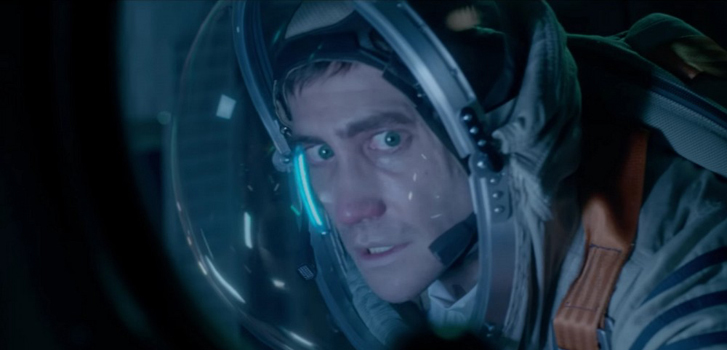
Without pomp or flur, Life made its way to the big screen. I find myself browsing trailers for upcoming films often, and this one totally snuck by me. It popped into existence the same way real life must have on planet earth: poof! It struggled to find its way into my schedule, and I am pleased to say I am glad that it did. A mixture of Gravity and Alien, this film has a lot to offer visually. But, all new life begs dissecting upon its end, so let’s put on the gloves.

In orbit around Earth, in a satellite similar in design to the current International Space Station with more advanced features, a returning space probe from Mars is recovered with difficulty after hitting space debris on its return. The space probe returns with samples from Mars’ surface containing a single celled organism in hibernation. Through trial and error the space station team is able to revive it, only to in turn lose control of it. And thus the plot begins like every sci-fi horror film involving alien life. Then again, all life has the same basic building blocks, so give it a pass and move on to the bigger picture. This film, like more recent sci-fi, exists on a spectrum; one extreme is pure science, the other pure fiction.
In the old days, due to the limitation of film technology, a film would have to exist very closely to either extreme. Furthest into fiction is films like Star Wars. Further removed from fiction, 2001: A Space Odyssey is an example of a feature so far in the future, it sits pretty far into the fiction scale, but with powerful film techniques was able to sample more of the science of space than ever before on screen. Alien would be released 11 years later, but would forgo all the floating space effects in favor of fiction with a science filter; a filter advanced by the current knowledge of space travel, but not concerned with it the way 2001 was. Flash forward to 2013 with the release of Gravity, and a new vision with an even greater level of faux realism has advanced the way we are able to express the realities of space. Life takes advantage of these techniques, but in a film drenched in fiction horror, it actually came off as a distraction. Showing the reality of space makes sense in films like Gravity, Apollo 13, and Space Camp, because reality is actively the antagonist. In Life, reality shares dramatic screen-time with our space monster, hogging the spotlight in certain scenes, albeit being the double-edge sword used to fight the monster. This is the films single biggest folly, coming off as more of a poor man’s Alien than a contender for great science-fiction.

Splitting hairs is for barbers, atoms for scientists, scenes for film critics. You will get a chance to enjoy a few choice homages from 2001, Alien, and Gravity. Or maybe they aren’t homages as much as they are just part of the blueprint of semi-realistic space films. There is also a great level of acting talent in this film, but honestly, we at AVOutput couldn’t stop laughing everytime Jake Gyllenhaal was on the screen. They seemed to pick the takes where he made the most out of character faces for situations. I couldn’t help but feel at any moment he would just start cracking up, or maybe there was a harness stuck in his crack. The monster is also one of the most entertaining I had watched in film for a long time. Both intelligent and ruthless, it was written as an analogy for the struggle life must face to survive, evolving from prey to predator on screen.

By the end, Devmani and I couldn’t agree on the quality of the film. He felt that it was a poor man’s Alien, often falling in the same pitfalls as Prometheus, the Alien prequel. I on the other hand found it engaging because unlike Prometheus, the characters give reasons for their actions. Hate, desire for greatness, friendship, family, every action that you might think is stupid is given reason. And from beginning to end, especially the end, this film was entertaining and rewarding. See it while it’s still alive.
~*8.5/10*~
Leave a Reply