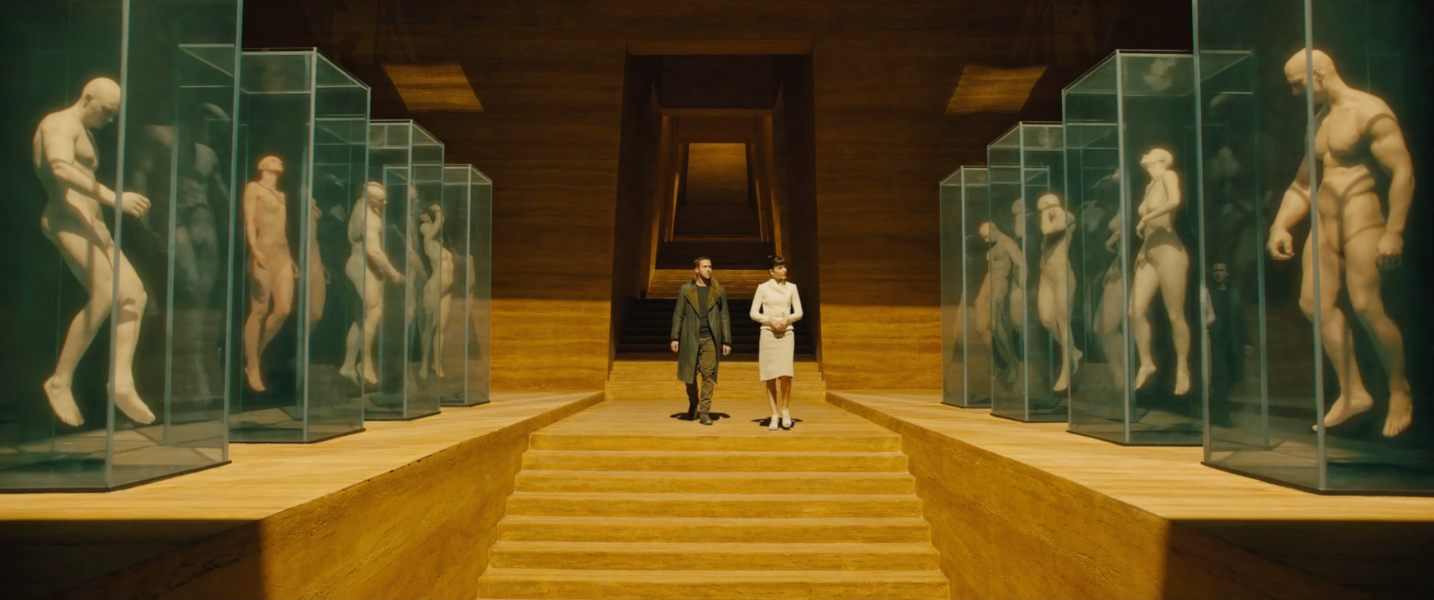
Lonely. Forlorn. Empty. Imagine if you will, a large sprawling museum, maybe The Met, and you are there all alone at night. It is sparsely lit and from one light to the next is a pitch black darkness. You can feel yourself leaving the light with every step. In the darkness, you are aware of the immense size and depth of the structure around you. Despite straining to hear, your own footsteps are mute. You’re senses are on high alert but you are alone. So alone and you are desperate for someone to speak, but along the museum walls are but history and paint strokes, impressions that people were once there. This was the overwhelming impression I waded through in Blade Runner 2049.

From the outset, director Denis Villeneuve puts forth a tremendous effort in recontextualizing the world Ridley Scott revolutionized film with over thirty years ago. From the breath exhaled upon the original Blade Runner’s release came so many sci-fi film influences. The sequel has returned to inhale all of them, consuming the triumphs and criticisms, the innovations and advancements, culminating in an enthralling experience that is rarely matched in mainstream cinema. The loudest influence of all seemed to be Akira, a 1988 animated film from Katsuhiro Otomo, of which the original Blade Runner was a huge inspiration. The visual similarities were everywhere; the architecture, the set dressings, the costuming, the vigorous detailing. There is a vivid richness to the 2049 world that when placing it next to the original for scale, 2049 completely dwarfs it. The original now feels narrow, tight, and intimate. The crowds are outweighed by the sheer size of the city and its monstrosities.

In his new world, Villeneuve directs a story removed from Scott’s original. The classic film noir flow is completely missing from 2049. Where the original explores the soul of man and its relationship to machine, 2049 reverses the equation and we are exploring the world through the eyes of a machine searching for a soul. Over thirty years, the process for retiring replicants has been improved and no longer requires long questioning and interviews to tell the difference between human and “skinjobs”. While still a detective story, it is much more a story of self discovery. Also, there isn’t a dame to save.

Sitting through this film was daunting and at times terrifying. It has this way of making you feel small. However, I can’t help feel that Ryan Gosling, playing the main character “K”, could have found a bit more in the space between his silence and delivery. I often think that Gosling is a better actor when he isn’t saying anything, and while I connected with him in the film, I couldn’t help but feel that it was a performance and not an extension of himself. It could have been that father of the new wave of androids, Niander Wallace, played by Jared Leto was considerably unsettling by comparison. Wallace is portrayed as the larger threat in theory, but somehow never finds a place in the story to roost. Rick Deckard, our returning hero from the original with Harrison Ford reprising the role, is much less of the Rick Deckard you would remember. Thirty years may have passed, but instead of becoming more of a character, he just feels like he could be any of Ford’s previous roles. Ford gives him no real definition. On the other hand, the leading ladies of the film, intelligent hologram Joi (Ana de Armas) and Wallace’s relentless android assistant Luv (Sylvia Hoeks) were both incredible. They both are deep wells of emotion and desire despite the condition of their design. The last major criticism I have is that while the film may have a couple of twists, for the most part, I found myself ahead of the story based solely on educated guesses. The pacing exacerbates this by giving you so much time to think in between its long, somber tracking against dark, meticulously designed scenery. And yet despite knowing where the story is going, you are drawn deeper and deeper, like hypnosis.

Blade Runner 2049 isn’t for everyone. With a two hour and forty minute runtime, it runs on your internal clock about twice that. Its cinematography and sound design slow your entire world down. I am still convinced the world around me was moving twice the normal speed. And while I may have talked down some of the acting, it was still intriguing and delightful, a caliber designed for this particular cinematic foray. This was by and far the most engrossing experience I have had this year. If I had one suggestion, I would say see this alone. It will certainly pull you in deeper if you can’t reach out and touch a familiar hand. This is sure to be a long held classic that will give rise to even bigger and better films in and outside the genre. I’d bet my right eye on it.
~* 9.5/10 *~
Leave a Reply