This is the 3rd out of 3 articles. Find the second here.
It’s time to get down to mythril tacks. At this point, I have talked about what this game meant to me when it was released and how it’s newest installment fared as a game. Finally, it’s time to talk about the impact the Remake has on what has unexpectedly become a robust and diverse universe. What does this mean for us at large, the players? This is a no-holds-barred SPOILER frenzy about anything and everything in the Squaresoft/Square-Enix pantheon. This means not just the games in the orbit of Final Fantasy VII, but the entire catalog at Square-Enix. To be honest, this is just the introduction, I don’t know if I even have an intent of going so far beyond the purview of the Remake, but in the spirit of the Final Fantasy gatekeeper, Tetsuya Nomura, I refuse to limit myself.

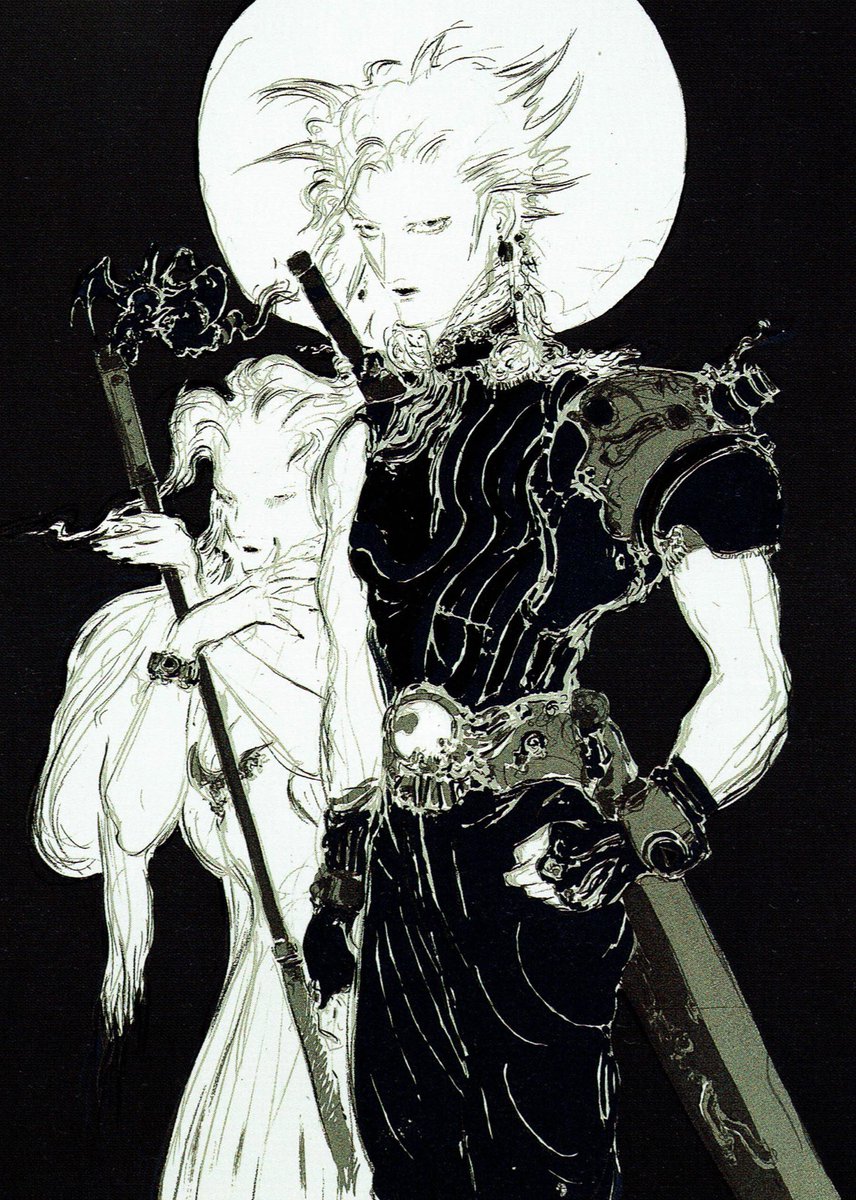
It’s been almost exactly a month since I started writing this article. It took so long to come back to this because I kept finding more and more content related to Final Fantasy 7 that I either forgot about or didn’t even know existed. On my own shelf sits Advent Children, Dirge of Cerberus, and Crisis Core. I decided to watch Advent Children immediately after beating Remake. As a movie fan and amateur critic, the film is littered with terrible film decisions and was clearly the work of people who spend much of their time penning and creating video game stories. It’s a series of cutscenes without a controller attached and at a certain point, you realize Advent Children was never meant for film fans, but for fans of the game. Specifically for fans desiring an epilogue and more directly fans of Cloud, Tifa, and Sephiroth. The story is almost unintelligible because there is tons of connective tissue left to be assumed by the viewer. It is at once too far removed from FF7 in both linear real time and in-game universe time to be recognizable, and simultaneously inexplicable in what has transpired and why. It takes a crack at explaining it from moment to moment, but largely, it looks like they were looking for excuses to push the characters to act. I am not trying to review the film but rather my intent is to create a modus opendai for the gatekeeper, Mr. Nomura. The more I learned about the world of FF7 that was being created over the years, the more it seemed to lean on the stylings of this one man. In a way, Nomura launched Squaresoft and himself into a whole new stratosphere of fame and broke all expectations. In my first article, I mentioned that for a certain generation of fans, it was the perfect storm, but I would later find out the cause of the storm was Nomura breaking open lightning in a bottle, releasing his brand of design on the world with a multi-million dollar international company backing him.

If I may, let me take a parallel series by the same creator infested by the meta of his own other original creations, namely Kingdom Hearts. In its inception, it looks like two producers at Square were trying to make a 3-D adventure platformer game with characters as popular as Mario, but only the biggest brand on earth, Disney, could possibly beat the king of platformers. Nomura was… walking by and pushed himself into the conversation, and they decided if they could do it, they would let him direct. (Read more here) Yada yada yada, Kingdom Hearts was created. While I can’t seem to find (and didn’t look too hard to find) proof, I can only imagine that with KH having a tenuous new relationship with big-corp Disney, they focused more on a simple game that was straightforward. KH is very much a disney product with a little bit of artificial Nomura sweetener. With its unbridled success, Nomura was unleashed. Kingdom Hearts 2 would go on to be, in my opinion, one of the most unintelligible video game stories ever inscribed to plastic discs. But the power of Nomura’s story-telling is that we all understand it differently. He creates bedrocks, little story islands of unshakable facts that are connected via a salty sea of undefinable liquid moments. Cast out to sea, rudderless and deprived, you try to bring to your mouth this brine only to be dehydrated faster than if you had just sailed the sea and died in the sun between fact islands or lived long enough to tell the tale. And that metaphor is my tribute to Nomura. Long, winding, hard to remember, and just clear enough that you think you got it, but you still have problems with its construction.

It has now been over two months since I have last visited this article. What is keeping me from continuing? The incomplete nature of my knowledge of Final Fantasy VII lore. Unlike the Kingdom Hearts sea, VII is like a series of interconnected caves, and the more you unearth the more you learn. And therein lies the problem. The Nomura-verse is composed of both his methods and his circumstances. His methods, we have discussed, but his circumstance is game development. Unlike movies or books, games obviously have an interactive capability, but they also have a variable development cycle. Some titles come out quickly, others span decades. They also consist of different teams, story writers, directors, and a myriad of producers. This in turn can make it much harder to make a solid universe, especially when new additions start off in a place where a continuous story was never meant to exist. Nomura is at once hindered and strengthened by his circumstances. He can’t tell a better story because the development cycle of his vision is variable, and success is based on sales and popularity. Without success, he can’t create a new addition, and often in games, the end is meant to tie the whole thing up. Were there to be a sequel, a whole new story is thought up and tacked on wherever it fits. Gamers are pretty forgiving of this concept. Still, at the same time, Nomura probably wouldn’t make a concise story because it’s not his style. For comparison, see the Dark Souls series. A game that both has deep lore and an involving story, but at the same time, the game doesn’t require you to know a single point to continue moving forward. This is almost the antithesis of Nomura’s style. In Souls, they let the player decide to explore its story caves, but doesn’t confront them with it to continue advancing. This is a strength of video games. A strength that Nomura keeps using to his disadvantage.

Yet, Final Fantasy VII still excelled to unparalleled heights. It engages you in the same way all of the previous games in the series have, but with a slight departure on the strict fantasy theme, instead a merger with steampunk or semi-future. The series was changed forever, and so was gaming. Instead of doing the Dragon Quest method, expanding on the same universe design with different stories, Final Fantasy was emboldened to try completely random approaches with vector entries like VIII and X. For longtime fans, or fans of their original design, Every future title, MMO or Single Player, would go on to be successful, but not fully realized in their original context. Even the return to form in IX was much more playful than any of the original six entries. Gaming franchises have since become playgrounds for developers. Once they are accepted by fans, developers are emboldened and experiment with what would normally be a new IP, but instead use the financial shield of the famous namesake to move forward with new ideas. And in the case of Final Fantasy, when this concept of change works, it means that every numbered game becomes a wildcard. It’s a double edged sword for a gaming franchise that dates back to the 8-bit era. It has fans over 40 years old by this point and they may be willing to buy anything new. But this isn’t new to you and it isn’t a revelation for me. Final Fantasy VII Remake causes me to reckon with these demons I had buried years ago. It rips off a scab I thought had healed. I had given up on the past, a past where I was excited for a singular story, contained in a single universe, in a single title. I had given up on the glory years of Final Fantasy, but the Remake took me back and said, what if we told you everything you remember about the original was true, and everything we added after that was also true, even though you probably didn’t play it or even know it existed. Even if you do your very best, you probably won’t be able to track the story or interconnected characters if you aren’t in the know. It’s like joining a group of long time friends that are constantly referencing inside jokes, all of them just winking at each other, nudging you in the ribs and asking, “Do ya get it?” Truly, the Remake series thus far makes me feel lost at sea when what I wanted to feel like was coming home.

This retrospective has left me feeling broken. Based on the end of the FFVIIR, I sought out to reconcile all of the loose ends to all the connected media. However, spending time with the prequel Crisis Core for over around 40 hours, I realized this was a crapshoot. None of it mattered. It didn’t enrich the characters, it only made the story longer. It just added wibbly-wobbly, timey-whimey “facts” to an otherwise complete(ish) origin point. The FFVII universe can’t handle the weight that is put on it. It’s a faulty bridge over a treacherous pass. On the other hand, that same bridge for some is a point of excitement. You tread the boards, one by one, testing your weight, hoping to get to the other side intact. And I think that is why we keep trying these games and why they keep getting made. We don’t want the fun to end, despite the fact that it has nothing left for us to be excited by. It’s a closed loop that we keep looking for something new in. By the end of the Remake, we are somewhere between ⅓ or ½ way across the faulty bridge, dangling between where we have been and where it is taking us. At this point, I am too mentally exhausted from trying to make sense of it all. Yet I am incapable of not enjoying it, the mental somersaults one does to understand the interconnected mess that is Final Fantasy VII. It’s too dear to me. I got on the bridge for so many reasons, but the biggest one is to be on the other side with all of the other fans who dared to play and dared to complete the game. To be in the know, to wink across the room. I want to be in that hyper-critical utopia where we all have one thing in common: We played Final Fantasy VII in 1997. And we all have something to say about it.
Leave a Reply